Home Blog Why QA Matters in Development and How Website Testing Saves Your Project Budget
Technologies
Why QA Matters in Development and How Website Testing Saves Your Project Budget
Imagine a familiar scenario: you want to build a website, whether it is a landing page, a corporate site, or a large e-commerce platform. You hand the project to a team of experienced developers and designers. Everything seems to be going well, but time passes, deadlines loom, the release date approaches, and then someone on the team asks, “Are we going to test the website before launch?”
At this point, you start thinking about the cost of QA and the additional expense, which can be considerable. It may seem unnecessary: surely experienced professionals will not make mistakes. Why pay for something that will only improve software quality “a little” but increase the budget? Yet the paradox of the digital world is that skipping quality assurance is the most expensive way to release a product.
Today, we will explain why QA matters in development, how testing actually saves money, and why testing is essential to the successful launch of any digital business.
Why does developer self-testing always end badly?
To answer this question, let us look at a typical website development process without a QA engineer. The founder clicks through the new pages, the developer checks that the “Buy” button works, and the project goes straight into production. But the developer wrote the code and knows exactly how the feature is supposed to work. As a result, they subconsciously follow the ideal route known as the “happy path.” Mapping user journeys can help the team look beyond that ideal route; Bato’s UX/UI design process includes user-flow work that makes these scenarios easier to identify before development.
Now consider what a QA engineer sees and where the real business value of testing lies. Their job is to break the system and prevent defects before a real customer encounters them. For example:
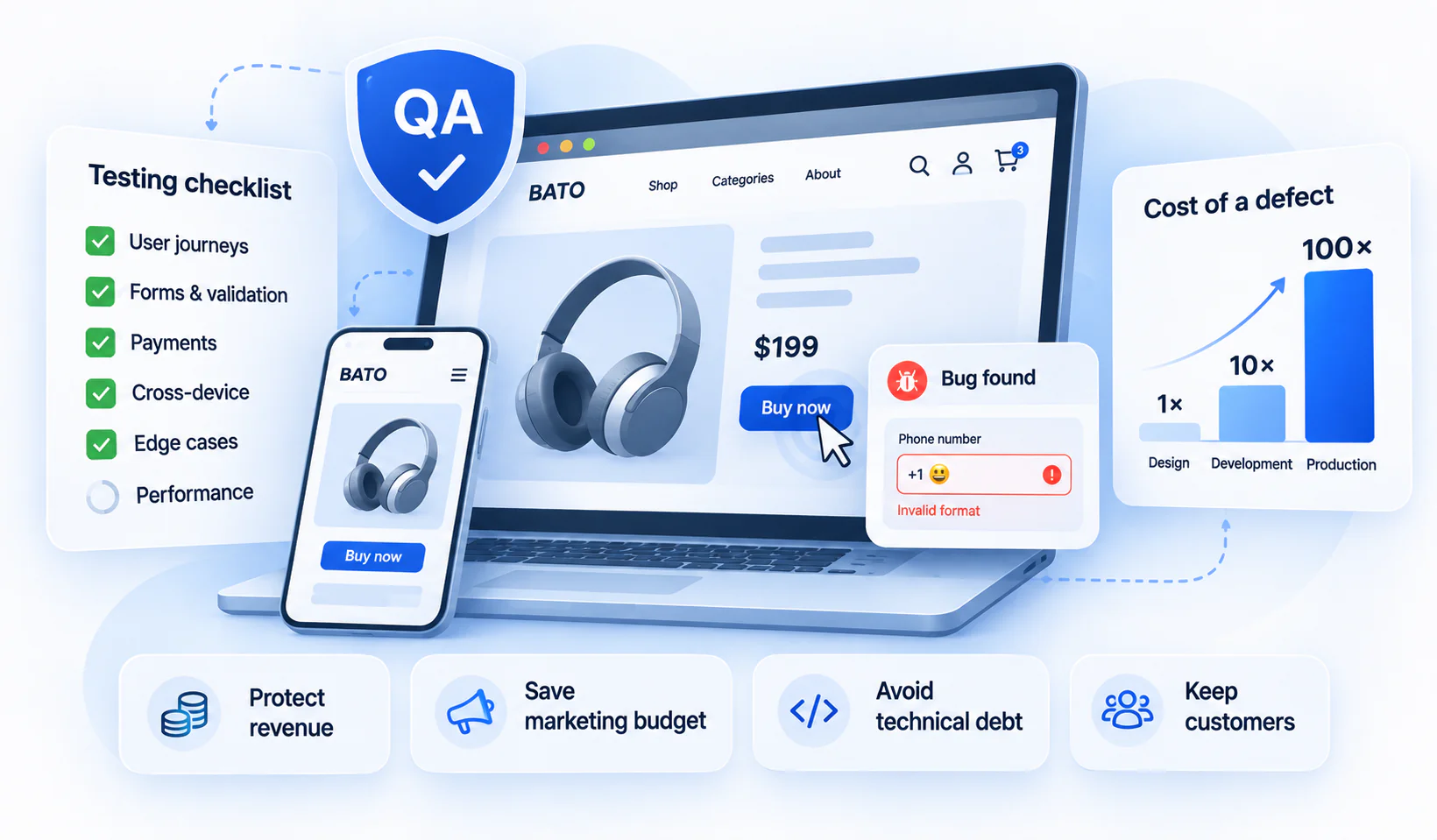
What happens if someone enters an emoji in the phone number field?
What happens if a user clicks “Pay” three times in a row because their internet connection is lagging?
Will the cart open on an older smartphone running an uncommon browser engine?
If QA testing does not answer these questions, your customer will. And believe me, their answer will be very expensive.
How Software Defect Costs Grow: The 1:10:100 Rule
In software engineering, the fundamental Cost of Quality rule has been recognized for years. These are not fixed monetary amounts, but a progression showing how the cost of a defect in the code multiplies at each stage:
Requirements and Design Stage (1x Progression): Finding a logical gap in the requirements or a Figma design takes only a few minutes. By introducing QA at an early stage, the team may only need to delete a line from a document or move a block in the design.
Development Stage (10x Progression): Once a defect reaches the code, fixing it costs hours of a developer’s time. The developer must stop the current task, locate the problem, rewrite the code, and create a new build.
Production Stage (100x+ Progression): A defect that reaches live users costs hundreds of times more. The total includes emergency overnight hotfixes, lost sales during downtime, an overloaded support team, and customers who leave.
What Happens If You Skip Software Testing: A Hypothetical Apple Case
Imagine the following situation. It is September. Tim Cook is presenting a new iPhone on stage. Millions of fans and buyers around the world open apple.com at the same time to place a preorder. Then, because of an uncaught bug in the shopping cart script or a failed payment gateway integration, Apple’s official website goes completely down for two hours.
Let us estimate what this two-hour outage could cost the company:
Direct Revenue Loss On peak launch days, Apple processes millions of dollars in sales per hour. If the service is unavailable for two hours, the company can immediately lose tens of millions of dollars in potential direct transactions.
Wasted Marketing Budget The presentation, livestream, and display advertising all cost enormous sums. The traffic arrives, but the landing page does not work. Millions of dollars in marketing spend are effectively wasted.
Overloaded Support and Emergency Hotfixes Dozens of engineers must abandon planned work and try to find the error on a live server under emergency conditions.
Reputational Damage and a Falling Share Price Media headlines erupt with the news: “Apple’s website is down.” The damage to the company’s image can drive its share price lower.
Now Back to the Reality of QA
The most ironic part of this story is the cause of the disaster. It could be a simple defect: a developer may have failed to account for API load, or address-field validation may not have been tested in the design. If a QA engineer had run load tests and boundary-value scenarios a week before release, the fix would have cost almost nothing. According to a public study by NIST (the National Institute of Standards and Technology), fixing a defect after launch can cost up to 30 times more than correcting the same problem during the design stage. A structured discovery phase, with requirements, technical analysis, and cost estimates agreed early, helps teams reduce uncertainty before development starts.
Where Exactly Does QA Save a Project Money?
When a business looks for ways to reduce website development costs, the answer lies in the losses that testing prevents:
Protecting Direct Revenue (Checkout and Lead Generation) What is the point of a perfect sales funnel if payment processing fails at the final step? QA checks every edge case so the business does not lose customers.
Protecting the Marketing Budget A company spends $5,000 on advertising, but the order window does not open for 40% of mobile users. Without quality assurance, that marketing budget can be wasted within hours.
Preventing Technical Debt When defects are patched directly in production, the code becomes an unmanageable mess. Technical debt grows, and adding a simple button requires rewriting half the website. QA keeps the codebase from descending into chaos. Bato’s web development flow includes quality assurance before deployment, making testing part of delivery rather than an afterthought.
Customer Retention According to PwC, around 32% of customers will permanently leave a brand they love after a single negative experience. Acquiring a new customer costs five to seven times more than retaining an existing one.
FAQ:
Why test a website before launch if the developers have already written unit tests? Unit tests check isolated pieces of code. They do not show how the website behaves in a real browser, over a poor 4G connection, or when a real person takes an unexpected action.
How much does a defect cost in production? It depends on its severity. Fixing a typo in the footer takes minutes. A critical shopping cart defect, however, can cost the company an entire day’s revenue plus the expense of an emergency rebuild.
Does a small project or MVP need QA? Yes. The purpose of an MVP is to test a business hypothesis. If users leave because of technical failures, you may wrongly conclude that the idea did not work when the real problem was simply a broken interface.
How can you demonstrate the value of testing to investors (testing ROI)? Calculate it in terms of avoided risk. If the QA testing budget was $1,500 but prevented a payment-system outage during a sale, that investment protected tens of thousands of dollars in direct revenue.
An SEO website migration changes more than the technology behind a site. Moving to another CMS, frontend framework, hosting provider, or domain can alter the HTML, metadata, internal links, URLs, and the way crawlers access content, even when the design appears unchanged. Search engines need time to recrawl and process pages. The team’s job is […]